
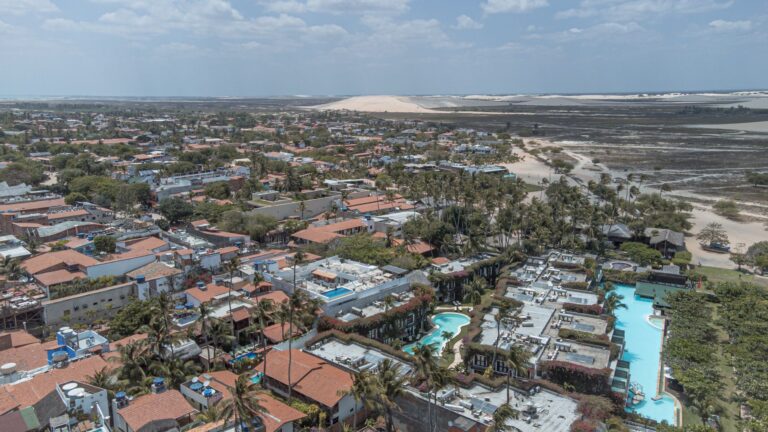
Jericoacoara, located in Ceará state along Brazil’s northeastern coast, represents one of South America’s most accessible yet unspoiled beach destinations, combining dramatic natural landscapes with authentic cultural experiences at a fraction of the cost of more commercialized alternatives. The town attracts travelers seeking authentic coastal life, windsurfing opportunities, and direct access to protected natural areas without the infrastructure saturation found in larger Brazilian resort towns. Understanding what makes Jericoacoara distinctive—from its geographic isolation to its preserved ecosystem—helps travelers make informed decisions about including it in broader Brazil itineraries.
Geographic Location and Natural Landscape
Jericoacoara sits approximately 240 kilometers west of Fortaleza, the capital of Ceará state, within the Jericoacoara National Park established in 2002. The town occupies a narrow peninsula surrounded by the Atlantic Ocean on three sides, creating a natural barrier that historically limited development and preserved the environment. The landscape features dramatic sand dunes, freshwater lagoons, and rock formations including the distinctive Pedra Furada (literally “pierced rock”), a natural stone arch that rises from the ocean and serves as the town’s most recognizable landmark.
The Jericoacoara National Park encompasses 13,360 hectares of protected coastal habitat, including mangrove forests, dune systems, and marine areas. The park’s designation came after decades of grassroots conservation efforts by local residents and environmental organizations who recognized the ecological value of the region’s unique ecosystems.
Access, Transportation, and Practical Logistics
Reaching Jericoacoara requires either a 5-6 hour journey from Fortaleza by car and buggy (a small open-air four-wheel-drive vehicle), or a flight to nearby Jijoca airport followed by a 30-minute transfer. The lack of direct highway access—the final approach involves crossing sand roads through dunes—has intentionally preserved the town’s isolation and limited mass tourism development. Travelers typically arrange transportation through their accommodation or hire private drivers in Fortaleza, with costs ranging between $40-80 USD for the round-trip journey depending on group size and vehicle type.
The town itself operates without traffic lights or chain stores, with most services concentrated along two main sandy streets. Local guides offer organized tours to natural attractions including freshwater lagoons such as Lagoa Azul and Lagoa do Paraíso, with prices typically between $15-30 USD per person for half-day excursions.
Water Sports and Recreational Activities
Jericoacoara’s consistent trade winds and shallow, protected lagoons make it one of Brazil’s premier windsurfing and kitesurfing destinations, attracting athletes and enthusiasts from across South America and Europe. The town hosts several specialized schools offering equipment rental and instruction, with beginner lessons typically costing $50-70 USD for two-hour sessions. Beyond wind sports, visitors engage in snorkeling, dolphin-watching boat trips, and fishing expeditions in the surrounding waters and lagoons.
The Lagoa do Paraíso, located 30 kilometers east of town, has developed a reputation as one of Brazil’s most beautiful natural swimming holes, featuring warm freshwater surrounded by palm trees and sand dunes. Day trips to the lagoon typically cost $25-35 USD per person and include transportation, lunch, and several hours of swimming time.
Historical Development and Tourism Evolution
Jericoacoara transformed from an isolated fishing village of approximately 500 residents in the 1990s to a recognized international destination supporting roughly 2,000 permanent residents and hosting 100,000+ visitors annually by the 2010s. The town’s development followed a distinctive pattern compared to other Brazilian beach towns—local residents and small-scale entrepreneurs led tourism development rather than large hotel chains, resulting in a predominance of pousadas (family-run guesthouses) and locally-owned restaurants. The 2002 creation of Jericoacoara National Park formalized environmental protections while simultaneously increasing the destination’s international profile through conservation media coverage.
The establishment of the Jericoacoara Wind Park in 2017, which generates renewable energy from the region’s consistent winds, represented a significant infrastructure development that improved electrical reliability while maintaining the town’s commitment to sustainable practices. This project demonstrated how the town balanced economic development with environmental stewardship.
Accommodation, Food, and Budget Considerations
Accommodation options range from basic hammock-and-fan setups costing $10-15 USD per night to mid-range pousadas charging $40-80 USD for private rooms with air conditioning and private bathrooms. The absence of major hotel chains means that booking directly with property owners through email or platforms like Airbnb typically yields better rates than using international booking sites. Many establishments operate seasonally, with reduced prices and availability during lower-demand periods.
Local restaurants emphasize fresh seafood, with meals typically costing $8-15 USD for mains at casual establishments and $15-25 USD at more upscale venues. The town’s small size means limited restaurant variety, though quality remains consistently high due to local competition and access to daily fish catches from the fishing community.
Environmental Conservation and Sustainable Tourism
Jericoacoara’s environmental management represents a model for sustainable coastal tourism in Brazil, with restrictions on vehicle access in sensitive dune areas, marine protection zones prohibiting fishing during breeding seasons, and community-based tourism guidelines limiting visitor numbers in fragile ecosystems. The National Park authority works with local guides and tour operators to enforce these regulations, creating a system where environmental protection directly supports the livelihoods of residents dependent on tourism. This alignment of economic and conservation interests has proven more effective than top-down restrictions alone.
The town’s refusal to permit large-scale resort development or commercial jet ski operations stands in sharp contrast to destinations like Cancún or the Gold Coast, where environmental degradation preceded regulatory intervention. Local organizations including the Jericoacoara Environmental Association continue advocating for policies that prioritize ecosystem health over short-term revenue maximization.
Cultural Experiences and Local Community
Beyond beach activities, Jericoacoara offers genuine cultural immersion opportunities through interactions with fishing families, participation in beach volleyball games, and attendance at local celebrations marking religious holidays and community events. The town maintains a bohemian character reflecting its history as a refuge for artists, musicians, and travelers seeking alternatives to mainstream tourism, with numerous small galleries, live music venues, and informal cultural spaces operating throughout the town. Visitors interested in traditional knowledge can arrange conversations with fishermen about sustainable fishing practices or learn about local herbal medicine from community members.
The annual Jericoacoara Festival, held at varying times throughout the year, celebrates local culture through music, dance, and traditional food, offering visitors insight into Cearense (Ceará state) traditions and regional identity.
Frequently Asked Questions
What is the best time to visit Jericoacoara?
Jericoacoara maintains warm temperatures year-round, with water temperatures never dropping below 26°C (79°F). The town experiences consistent trade winds that make conditions ideal for windsurfing and kitesurfing throughout the year, though wind intensity varies seasonally. Accommodation availability and pricing fluctuate based on visitor demand, which peaks during Northern Hemisphere winter months and Brazilian school holidays.
How many days should visitors plan to spend in Jericoacoara?
Most visitors spend between three and five days experiencing the main attractions including Pedra Furada, Lagoa do Paraíso, Lagoa Azul, and participating in water sports or beach activities. Travelers with specific interests in windsurfing instruction or those seeking extended relaxation may extend stays to a week or longer, while those prioritizing beach town variety across multiple destinations may spend just two days before traveling onward.
Is Jericoacoara suitable for budget travelers?
Jericoacoara ranks among Brazil’s most budget-friendly beach destinations, with daily expenses of $30-50 USD achievable through basic accommodation, local restaurant meals, and free beach activities. Organized tours and water sports instruction add to costs but remain significantly cheaper than equivalent activities in more developed resort destinations, making the town accessible to travelers across budget ranges.
Jericoacoara delivers the combination of natural beauty, authentic cultural experience, and practical accessibility that defines genuinely worthwhile travel destinations. The town’s preserved environment, sustainable tourism practices, and community-centered development create conditions where visitors engage meaningfully with both landscape and people rather than consuming pre-packaged resort experiences.
