
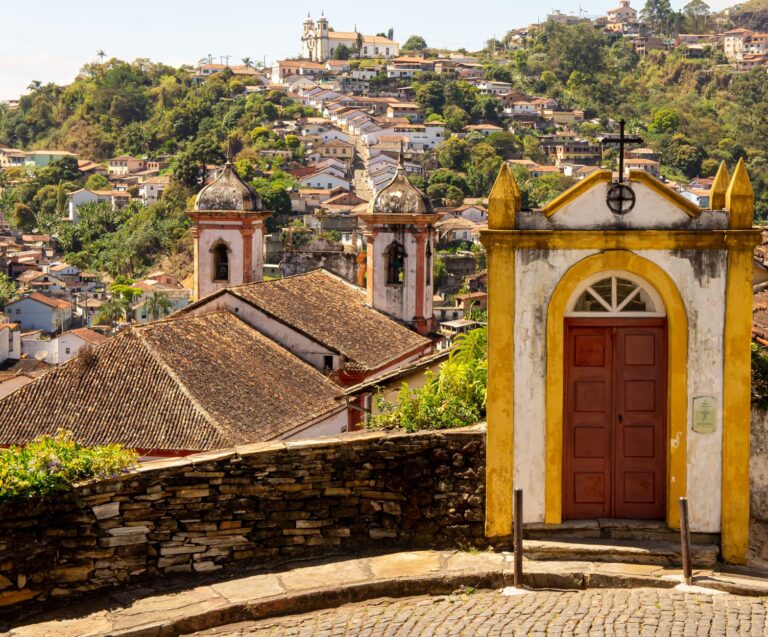
Brazil’s colonial towns represent some of the most well-preserved examples of 17th and 18th-century Portuguese architecture and urban planning in the Americas. These settlements emerged from Portugal’s expansion into South America and developed around mining operations, agricultural production, and trade routes that shaped the region’s economic foundation. Understanding these towns provides insight into Brazil’s cultural heritage, architectural evolution, and the complex history that defines the nation today.
The Origins of Brazil’s Colonial Settlement Pattern
Portugal established its first permanent settlements in Brazil beginning in 1500, but the colonial towns that travelers visit today developed primarily during the gold rush of the late 17th and 18th centuries. When gold deposits were discovered in the region now known as Minas Gerais in the 1690s, the Portuguese Crown implemented a deliberate settlement strategy to control mining operations and extract wealth. The Crown granted land to wealthy individuals called bandeirantes (explorers and slave traders) who established towns following a standardized urban layout based on Portuguese medieval models, featuring a central plaza surrounded by administrative buildings, churches, and residential quarters.
The mining boom transformed the economic landscape dramatically. Between 1700 and 1750, Brazil produced approximately 50 percent of the world’s gold supply, and this wealth financed the construction of elaborate churches, mansions, and public buildings that still stand today. Towns like Ouro Preto, Mariana, and Tiradentes grew rapidly from small settlements into prosperous urban centers, attracting merchants, artisans, craftspeople, and enslaved workers from across Portugal and Africa.
Key Colonial Towns and Their Distinctive Characteristics
Ouro Preto, located in Minas Gerais state, exemplifies the architectural grandeur of Brazil’s colonial period and served as the region’s capital during the height of gold production. The town’s name means “black gold” in Portuguese, referring to the oxidized gold found in the local streams. Its steep hillside layout, narrow cobblestone streets, and baroque churches showcase the wealth generated by mining, with structures like the Igreja de São Francisco displaying ornate gold leaf interiors that required skilled craftspeople and substantial financial resources to complete.
Mariana, also in Minas Gerais, represents another significant colonial center and holds the distinction of being Brazil’s oldest city established specifically as a town rather than developing organically around a mission or fort. Founded in 1696, Mariana features the Basílica de Nossa Senhora da Assunção, one of Brazil’s most important baroque religious structures, alongside residential architecture that reflects the living patterns of colonial merchants and administrators. The town’s two main plazas—Praça Gomes Freire and Praça Mina Brasil—retain their original colonial proportions and continue to serve as social and commercial hubs.
Architectural and Artistic Elements of Colonial Towns
The architecture of Brazil’s colonial towns reflects a synthesis of Portuguese baroque style adapted to local conditions and materials available in the region. Colonial builders used local stone and wood, creating structures with whitewashed walls, red tile roofs, deep wooden eaves, and shuttered windows designed to provide ventilation and protection from intense sun. Interior spaces featured azulejo tiles (hand-painted ceramic tiles imported from Portugal or created locally), intricate wooden carvings, and religious artwork that demonstrated both technical skill and artistic vision.
The most distinctive artistic contribution from colonial Brazil emerged through the work of Aleijadinho (meaning “the little cripple”), a sculptor and architect born in 1738 who created masterpieces throughout Minas Gerais despite losing the use of his hands to a degenerative disease. His work appears in the Igreja de São Francisco in Ouro Preto and the Basílica do Bom Jesus de Matosinhos in Congonhas, where his twelve soapstone prophets represent some of the finest baroque sculpture in the Americas. Aleijadinho’s legacy demonstrates how colonial towns became centers of sophisticated artistic production rather than merely administrative outposts.
Economic Transformation and the Decline of Mining Towns
The prosperity of Brazil’s colonial mining towns proved temporary, as gold deposits became exhausted and Portugal’s economic priorities shifted during the 18th century. When mining output declined significantly after 1750, these towns experienced economic stagnation that paradoxically preserved their colonial character—the lack of investment meant that buildings were rarely demolished or modernized, allowing the original architecture to survive largely intact into the modern era. The Portuguese Crown attempted to maintain control through the establishment of the Derrama (a tax collection system) and military presence, but resentment over taxation and colonial restrictions eventually contributed to independence movements.
The failed Inconfidência Mineira uprising of 1789 represented a pivotal moment in colonial Brazilian history, with local leaders including Tiradentes (Joaquim José da Silva Xavier) attempting to establish an independent republic. Although the rebellion was suppressed and Tiradentes was executed, the event reflected the growing tension between colonial subjects and the Portuguese Crown. Today, Tiradentes’s name identifies one of Brazil’s best-preserved colonial towns, located in Minas Gerais, which honors the revolutionary’s memory through museums, monuments, and annual commemorations.
Frequently Asked Questions
Which colonial towns are easiest to visit from major Brazilian cities?
Ouro Preto and Mariana are located approximately 100 kilometers from Belo Horizonte, the capital of Minas Gerais, and are accessible by bus or car in roughly two hours. Tiradentes lies approximately 180 kilometers from Belo Horizonte and can be reached by bus in three to four hours, while São João del Rei, another significant colonial town, sits nearby and offers additional accommodation options for visitors exploring the region.
What is the best way to experience colonial towns without spending excessive amounts?
Many colonial towns offer free entry to public plazas and exterior views of historic buildings, and several churches allow visitors to enter at no charge or with small donations. Budget travelers can stay in guesthouses and pousadas (small inns) located in colonial buildings, eat at local restaurants serving regional cuisine, and explore towns on foot following self-guided walking routes available through tourism offices or online resources.
Are colonial towns still inhabited, or are they primarily tourist destinations?
These towns remain active communities where people live, work, and conduct daily business rather than functioning as open-air museums. Residents occupy colonial buildings, local markets operate in traditional plazas, and schools and government offices serve the population, creating an authentic atmosphere where visitors experience living heritage rather than preserved artifacts.
Brazil’s colonial towns offer travelers direct access to three centuries of architectural, artistic, and social history embedded in the landscape and buildings of Minas Gerais and surrounding regions. These destinations provide opportunities to understand how Portuguese colonialism shaped Brazil while experiencing authentic communities that maintain their heritage through daily life and cultural practice rather than artificial reconstruction.
